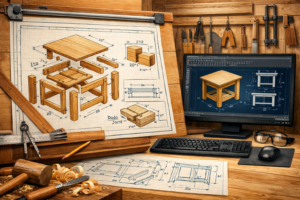
 A mechanical drawing is defined as a scaled illustration of a subject machine or mechanical part, or construction drawing of a fixture, product, or furnishing. It is a precision drawing, produced with the help of instruments, such as compasses, triangles, T-squares, etc., on a drafting board, or entirely in a Computer Aided Drafting (CAD) program.
Mechanical drawings are often produced in a reduced or enlarged scale of the subject so that definition of the parts and components can be easily defined. (ie. scale: 1 inch equals 2 inches, etc.)
A mechanical drawing will many times feature a fully assembled subject so that the concept of the subject can be more easily understood to the one reading the drawing. These are sometimes drawn in an isometric or 3d view to give more of the idea of substance and space to the subject. Then the subject itself is broken down into it’s individual parts so that these can be clarified by dimensions and notes for fabrication in a machine, metal fabricating, or wood shop.
Mechanical drawings are used in fabricating things like steel beams and columns for building structures, automotive and machine parts, woodworking projects, reference drawings included with instructions for assembly, etc.
Ancient mechanical drawings can be traced back to ancient Egypt and were known as infographics. These either told a story or illustrated a process and were mostly carved in rock or drawn on papyrus. The more famous historical mechanical drawings came from the pre-industrial era and were illustrations made by men like Leonardo Da Vinci.
This is a good summary on the history of Drawings and understanding them. I appreciate this summary. I like the way you went into detail about drafting originating from ancient times. I hope this website is expanded on, since i want to learn more about machine drafting and drafting in general. I have experience in AutoCAD and in SolidWorks.